
What We Can Know

May 2119.
Scholar Thomas Metcalf is obsessed with the lost poem “A Corona for Vivien,” written by Francis Blundy in honor of his wife’s birthday in 2014. Blundy read the poem, penned on a parchment scroll, at a dinner attended by family and friends—accounts of which have been preserved in journals of the time. They are the only people known to have heard or seen the poem.
Metcalf lives in what’s left of England following a catastrophic nuclear accident that submerged much of the western as the oceans rose. He longs to have lived in the world Blundy knew, rich with natural beauty, ripe with opportunity. He is determined to find Blundy’s poem despite the near impossibility of travel. England is a series of small islands; boats, bicycles, jerry-built funiculars and walking the only way to get from one place to another.
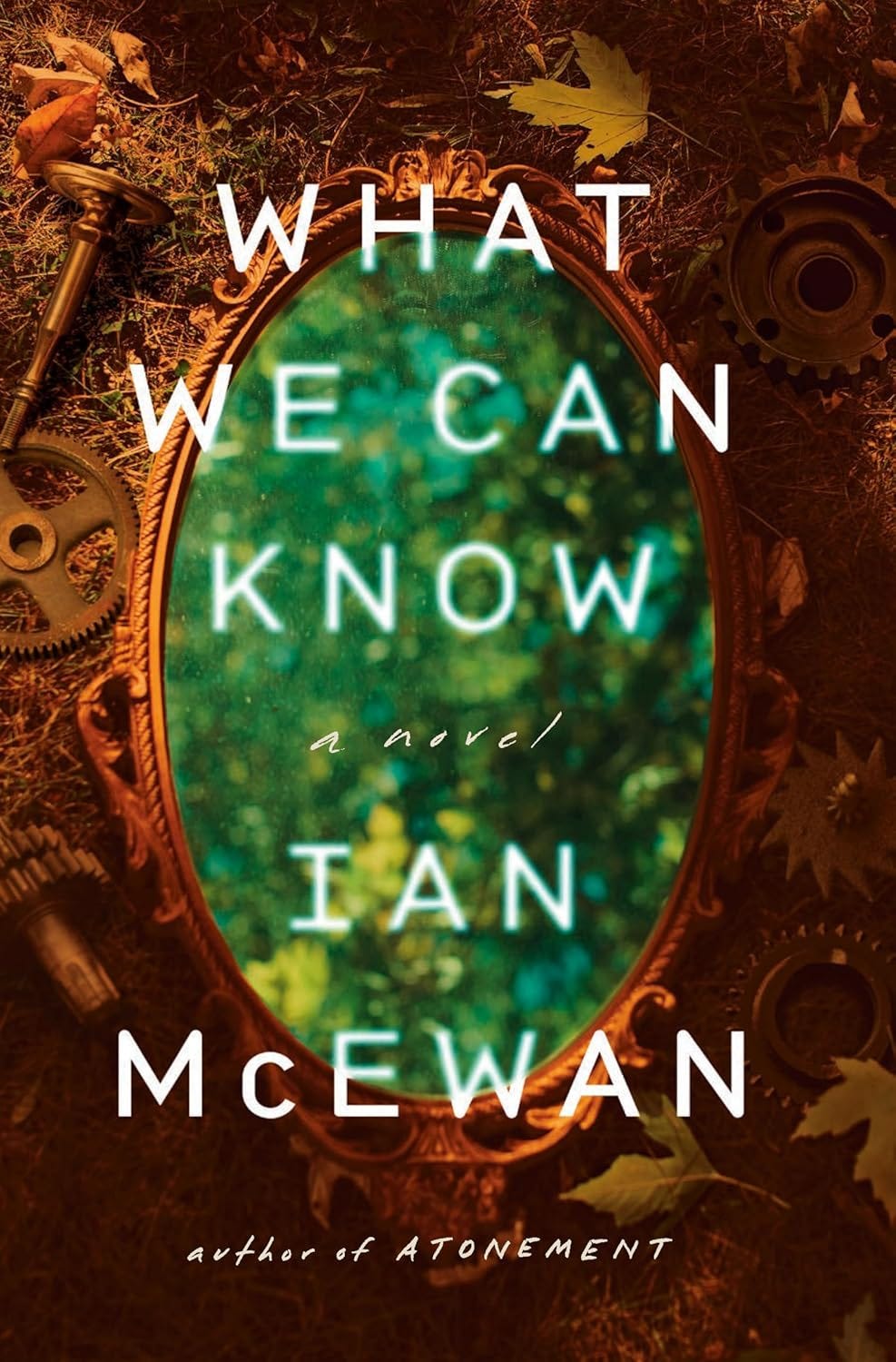
That’s the plot of Ian McEwan’s What We Can Know.
But, as McEwan’s epigraph from Richard Holmes’ Dr. Johnson & Mr. Savage suggests, there’s so much more than that:
“It concerns the kind of human truth, poised between fact and fiction, which a biographer can make as he tells the story of another’s life, and thereby make it both his own (like a friendship) and the public’s (like a betrayal). It asks what we can know, and what we can believe, and finally what we can love.”
Anyone who keeps a journal and reads it years after the fact has asked themselves, Why did I write about this instead of that? Or that or that or that? Anyone reading my journals would conclude I was perpetually miserable because, mostly, I write to try to understand some greater or lesser heartache, some problem it seems impossible to solve. The older I get the more I’m tempted to burn them. They tell so little of my life, show so little of who I really am.
At this point, I’m not really sure who I am? How could anyone else figure it out?
Speaking of her own journal, Vivien writes, “The past, jumbled in the mind, survives in its own special tense, a form of ahistorical present. A journal, whatever its quality, fixes events like beads on a string.”
And of friendship, “We talked into the night about our families, that deep well, the shifting story which, even as the years pass, still needs to be rewritten.”
Part One of What We Can Know tells the story of a time in Thomas Metcalf’s life in a world that anyone who believes we’re on the wrong path in terms of caring for our planet is scared to death to imagine. Honestly, being in that world was depressing as hell, much of the richness we take for granted accessible only through literature.
On the other hand, the earth survived. (At the moment, I’m not at all sure that it will.) And life was…life. Thomas was no less human for the state of the world he lived in. He struggled with love, ambition, balance and self-control, just as we do.
His part of What We Can Know falls into the literary detective genre, recounting the long process of seeking and interpreting clues necessary to discovering a lost and valuable poem.
Part Two is Vivien’s story—and what I love most about this novel is how truly shocked I was—having read Metcalf’s conclusions about Blundy’s circle in Part One—to read her account of what actually happened.
Wait. What actually happened? Not exactly.
Vivien admits to leaving things out, changing some things. But McEwan made me believe that she was telling the truth about the heart of her experience. At the same time, he made me viscerally understand impossibility of fully understanding anything or anyone.
What We Can Know is fraught with the most delightful ironies. Here’s one that doesn’t give too much away. As years went by and climate change went beyond threat to the time that McEwan brilliantly dubs “The Derangement”, when those threats became reality, “A Corona for Vivien” came to be considered a kind of ode to the natural world for its depiction of flora and fauna, birds and butterflies lost to the rising seas. Blundy, a known climate change denier, would have hated that; in fact, rumor had it that he accepted a huge sum of money from wealthy climate change deniers not to publish the poem.
Maybe Vivien will tell you whether or not that happened.
Maybe it’s just one more thing can’t know for sure.
McEwan’s novel is about climate change, biography, history. It’s about love, marriage, friendship. Most powerfully for me, it’s about the seductive dangers of nostalgia.
Thomas Melcalf longs to have lived in our time, seeing in it only what’s missing from in his own. So many people are doing this now, in our time, longing to remake the world in a faulty image of the past.
There is only one way: forward. But it’s so hard.
Barb: Another great review. I was already familiar with the book, having read the NY TImes review, but you reinforced my desire to read it soon. I've put it on my priority list.
Thanks! Look forward to reading yours. Agree about the Booker miss. Why?!?